
South Tyneside Adult Social Care Commissioning Strategy 2025 - 2027
Published 15 September 2025 An accessible strategy document from southtyneside.gov.uk
Foreword
From the Lead Member for Adults, Health, and Independence
It is with great pleasure that I introduce South Tyneside’s Commissioning Strategy for 2025-2027.
This document sets out our commitment to co-producing a healthier and happier South Tyneside with evidence-based commissioning. This strategy is not just a plan; it is a statement of our ambition for the residents of South Tyneside
Our vision is clear: South Tyneside: Where people live healthy, happy, and fulfilled lives.
To achieve this, we are committed to a strengths-based approach, putting people at the heart of commissioning, ensuring equality and accessibility to care and support services.
This means actively involving people in their care plans and building on their existing strengths. We strive for equity of outcomes and genuine choice and control for all.
This strategy is driven by a deep understanding of both the national and local contexts. We recognise the challenges we face, including an ageing population, the need for effective transition of young people requiring support, communities experiencing high deprivation, and rising cost of living pressures. We are committed to addressing the interconnected issues of employment, income, health, and digital access which particularly impact on us. However, we also acknowledge the opportunities these challenges present to work differently, drive change, and improve the lives of our residents.
Commissioning, for us, is about more than just securing contracts. It involves a comprehensive cycle of understanding needs, analysing challenges, developing options, and collaborating with service providers and, crucially, individuals who use services. We are committed to using evidence-based intelligence and data to inform our decisions, as well as the valuable insights from community engagement. We will work with our partners in Health services, and the voluntary, community, faith and social enterprise sectors to ensure the provision of high-quality health and social care services and the best use of the South Tyneside pound.
We will also seek to manage demand for support by intervening earlier and preventing needs from escalating. We are dedicated to delivering safe, secure, and high-quality services through appropriately trained and skilled teams. We recognise the importance of supporting people to stay in their own homes, close to their families and communities.
Our strategy includes clear governance arrangements, ensuring decisions are made transparently and with proper scrutiny. As lead member I will make decisions in conjunction with other council Cabinet Members. Our Overview and Scrutiny and Audit Committees are a key element of the Council’s corporate governance arrangements, to ensure that residents receive the services that are important to them, while at the same time ensuring value for money. We will also have an Annual Commissioning Plan that will detail the key commissioning activities that will be completed over the following 12 months.
This strategy has identified 10 key strategic commissioning priorities and a forward plan for the next two years. The delivery of this plan will transform the current commissioning landscape and allow for: stronger strategic alignment; support for independent lives; services that are based on the views of residents and carers; the use of innovation; and the effective use of technology.
Introduction
From the Director of Adult Social Services and Commissioning

I am pleased to introduce the South Tyneside’s Commissioning Strategy for 2025-2027.
This is a vital document that outlines our commitment to delivering high-quality, outcome-based services for the residents of South Tyneside. This strategy is not just a plan; it reflects our shared vision for a healthier and happier South Tyneside, where individuals live fulfilled and independent lives.
Our approach is firmly rooted in the principle of co-production, ensuring that the voices and experiences of those who draw upon services are at the heart of our decision-making processes. We believe that by working together with residents, carers, and partners, we can create services that are truly responsive to the diverse needs of our community. This strategy emphasises a strengths-based approach, building upon the existing capabilities and aspirations of individuals.
This strategy acknowledges the unique challenges faced by South Tyneside, and provide us with opportunities to innovate, drive change, and develop new ways of working in adult social care. Our commissioning model is designed to be flexible and adaptive, enabling us to respond to changing needs and maintain safe, high-quality systems of care.
The strategy demonstrates our commitment to delivering personalised services and embracing digital solutions to enhance independence and give people greater choice and control. It also sets out our commissioning priorities and the arrangements we have in place to govern and support delivery.
This Commissioning Strategy works in tandem with the objectives set out in our Living Better Lives Strategy and reflects the close collaboration with our Health partners, and other agencies, to provide better more integrated care services. We are committed to working together to ensure our residents receive the best possible care and support, enabling them to live better, more independent lives. I look forward to the positive impact this strategy will have on the lives of those we serve in South Tyneside.
Adult commissioning and this strategy
This document outlines our commissioning strategy for South Tyneside for 2025-27 including:
- The purpose of commissioning in South Tyneside.
- The local and national context for change and the role of commissioning in delivering that change.
- The vision for commissioned services in adult social care across South Tyneside.
- The key elements of the commissioning model and cycle in South Tyneside.
- Our commitments to deliver ‘best-in-class’ commissioning activities and services.
- The arrangements we have in place to govern and support the delivery of this strategy.
- Our Forward Commissioning Plan and key priorities.
This document also contains useful links and a glossary of terms to aid navigation and accessibility.
We have a strong commitment to partnership working in South Tyneside, in line with our dedication to delivering the ambitions of our Adult Social Care Living Better Lives Strategy and our broader Joint Health and Wellbeing Strategy.
This strategy is firmly focused on adult social care, ensuring that we provide high-quality, strengths-based services that enhance the health, wellbeing, and quality of life for all adult residents in South Tyneside.
However, we recognise the importance of collaboration and close working with colleagues within children’s commissioning, particularly in the area of Preparation for Adulthood. This strategy supports the smooth transition of young people into adult social care. Our commitment to joint working extends to collaborating closely with colleagues within the NHS including the North East and North Cumbria ICB and the South Tyneside and Sunderland Foundation Trust and other partners to ensure seamless and effective service delivery.
By listening, hearing, testing, and co-producing services with the citizens of South Tyneside, we aim to drive better outcomes across all stages of life, fostering a community where everyone can thrive.
We are working closely with Public Health. For example, our new Healthy Ageing Alliance, underpins our system wide partnership approach. This brings together the long-term conditions and frailty agenda together to take a more holistic and preventative approach. This arrangement supports our initiatives such as our Age Friendly Communities Action Plan and Strategy
What is commissioning?
Commissioning is the process by which health and care services are planned, purchased, and monitored in Borough.
It includes all the activities required to support these functions and often involves close working with other public service partners and health and social care service providers to seek to ensure that provision of high-quality health and social care and support services in South Tyneside.
The Adult Social Care Commissioning Service in South Tyneside Council is delivered by a specialist team of care professionals with experience and expertise in delivering these activities.
Integral to our commissioning process is the work carried out by the council’s Procurement Team. This close alignment is critical to deliver the requirements of the Procurement Act 2023 which was implemented in February 2025 and is now live.
Purpose
Our commissioning strategy is underpinned by a common purpose …
Co-producing a healthier and happier South Tyneside with evidence-based commissioning.
This purpose is supported by the following key principles that will guide our commissioning activities and the design of all our adult social care commissioned services.
Prevention and early help
- Prevention in social care is about encouraging people to be more proactive about their physical and mental health and wellbeing. It can increase independence and reduce or delay the need for care and support services.
- Supporting young people to transition from services for children in a way that prepares them for adult life.
- Working with NHS partners to prevent avoidable admissions to hospital and long-term service dependency.
- Working with our NHS and partners across health and social care to support safe and timely discharges from hospitals.
Reablement/enablement
- Reablement/enablement aims to help individuals regain their independence and improve their quality of life after an illness, injury, or period of inactivity. This approach involves short-term, intensive support and rehabilitation services designed to help people relearn daily living skills and regain confidence.
Care and support
- Care and support encompasses a wide range of services provided to individuals who need assistance with daily activities due to age, disability, or health conditions. This includes personal care, healthcare, social activities, and emotional support, tailored to meet the specific needs of each person.
- The care and support solutions are informed by strengths-based care and support plans, developed by our social work teams within the council. These plans identify and harness the strengths and abilities of individuals, ensuring that the support provided not only meets their needs but also empowers them to lead fulfilling and independent lives.

Support for carers
- Support for carers involves providing resources, replacement care, and assistance to those who care for family members or friends. This can include financial support, counseling, training, and access to support groups, ensuring that carers have the help they need to maintain their own wellbeing while caring for others.
Embracing assistive technology and digital
The Council is committed to enhancing assistive technology options and digital capabilities to support people in social care. This includes the use of assisted technology to help individuals maintain their independence and improve their quality of life. By utilising well-managed data, we ensure effective commissioning and the delivery of high-quality services. Additionally, the safe and considered integration of Artificial Intelligence (AI) in social care offers numerous benefits, such as predictive analytics for better care planning and personalised support.
These opportunities extend to our partnership arrangements, and our ambitions around shared resources, risk and outcomes. This strategy builds the bridge towards joint commissioning. In particular, the key themes of prevention, digital and technological transformation, early intervention and discharge from hospitals.
About South Tyneside
South Tyneside has a rich heritage, and our history has played a major role in regional, national, and even world history.
It was a military stronghold for the Romans and an important centre for early Christian church, where the Venerable Bede wrote his ‘Ecclesiastical History’. An area that was rich in coal with a key position on the River Tyne it has a proud industrial and maritime past and was at the forefront of invention and innovation in these areas. The Jarrow Crusade of 1936 was a key event in the town’s history.
South Tyneside is also renowned for its friendly, vibrant communities, who have welcomed incomers for centuries, giving it a rich and diverse cultural heritage. Celts, Romans, Anglo Saxons, Jutes, Vikings, the first Arab community in South Tyneside were the Yemeni in 1860 and more recently the settling of people from the Commonwealth, notably the Indian subcontinent, and the European Union reflects the present-day culture of South Tyneside.
As the council, South Tyneside is committed to Equality, Diversity, Inclusion and Belonging (EDIB) values. We recognise this is really important in making South Tyneside a place where people live happy, healthy and fulfilled lives.
Covering an area of 64 square kilometres and a population of 149,270 living in 72,000 households. South Tyneside includes the towns of South Shields, Hebburn, and Jarrow and the villages of Boldon, Cleadon and Whitburn and is an outstanding place to live, invest and bring up families.
South Tyneside demographics
The borough has a population of 149,270 residents.
Projections show that our population could rise to 151,778 by 2030 and 154,418 by 2040.
21.3% of our residents are ages 65 years +
59.8% of our residents are of working age (18-65)
20.2% of residents are below the age of 18
91% of educational establishments in South Tyneside were classed as good or outstanding by Ofsted.
90.7% of students aged 16-17 stay in education.
9% of 16–17-year-olds go into apprenticeships and 3.1% into employment or other forms of training.
6.4% of South Tyneside residents aged 16-64 are unemployed compared to 4.0% in England overall.
22.6% of residents in South Tyneside are considered disabled under the Equality Act.
0.8% of the local population of South Tyneside have a learning disability.
19.1% of the local population over the age of 16 are estimated to have a common mental health disorder (including depression, anxiety disorders, OCD, PTSD). This is a higher than rate than regional average (18.2%) or the national average (16.9%).
3.98% of South Tyneside residents aged 65 or over are estimated to have a dementia. This is similar to the national position.
The average life expectancy at birth in South Tyneside is 76.7 years for men and 80.8 years for women. This is compared to the national average of 79.1 years for men and 83.1 years for women.
94.4% of South Tyneside residents are white British with 2.9% Asian, Asian British or Asian Welsh. The borough has less ethnic diversity than the North East (where 7% of the population are an ethnicity other than white) or England overall (19% of the population are an ethnicity other than white).
National context for change
In January 2025, the Government launched an independent commission led by Baroness Louise Casey into adult social care to inform the work needed to deliver a national care service.
The commission will work with people drawing on care and support, families, staff, politicians and the public, private and Voluntary, Community, Faith and Social Enterprise sector to make recommendations for how to rebuild the adult social care system to meet current and future needs.
The aim of the independent commission will be to “work to build a national consensus around a new national care service able to meet the needs of older and disabled people into the 21st century”.
The first phase of the commission, reporting in 2026, will identify the critical issues facing adult social care and set out recommendations for effective reform and improvement in the medium term.
The second phase, reporting by 2028, will make longer-term recommendations for the transformation of adult social care.
In developing our local strategy, we recognise several national issues and challenges in adult social care commissioning. Achieving integration between health and social care remains a priority. This strategy was co-produced with local commissioning staff. We are committed to investing our own internal workforce and supporting the local market to have a strong and sustainable workforce.
Our strategy aims to meet the growing demand for services, ensuring that all needs are met. We will embrace technology to bridge cost and digital skills gaps, enhancing service delivery and efficiency.
Our focus is on commissioning based on outcomes rather than outputs, prioritising the quality of care. We are dedicated to reducing regional inequalities in access to care and providing sustainable, high-quality services for all.
Our Adult Social Care Strategy in South Tyneside – Living Better Lives sets out a number of key aims and objectives that align with the goals of the commission and support the extension of the principles of choice, control, independence, access, and fairness for those receiving care and support.
The Council is also committed to working with health and other local public service partners to provide better, more joined-up health and care services in South Tyneside (our ‘place’). Place is one of the foundational principles of our strategy.
The NHS in England has outlined a new long-term plan focusing on three major shifts to improve healthcare. Firstly, to move more services from hospitals to community settings, making care more accessible and reducing hospital pressures. Secondly, the transition from analogue to digital systems, enhancing efficiency and patient experience through technology. Lastly, the focus will shift from treating sickness to preventing it, promoting healthier lifestyles and early interventions to reduce the burden of disease.
The Council will actively support local health colleagues to deliver on the plan’s objectives, ensuring a modern, responsive health service. Through integrated commissioning and efficient health and social care systems, we will seek to improve the outcomes for individuals and communities. Working closely with colleagues from the Integrated Care Board’s Place Committee when exploring joint opportunities to commission services applying the principles of collaborative commissioning.



Local context for change

South Tyneside is a special and unique place.
The borough does have significant challenges, including areas of high deprivation and as a Northeast coastal area there is a strong legacy of intergenerational skills and health challenges within our communities. In South Tyneside, our commissioning strategy for adult social care embraces the principles of ‘a better you’ which means that everyone in South Tyneside is working together to improve health and wellbeing and residents feel happy and healthy. This strategy places residents and their physical and mental wellbeing at its heart, making it as easy as possible for residents to take the best care of themselves.
The aftermath of the COVID-19 pandemic and the new threats of rising inflation and skills shortages present multiple challenges, particularly as the long-term impact of the virus has yet to fully play out.
Such challenges include:
- Our towns adapting to changing shopping and working habits
- The mismatch between labour market supply and demand
- The need for upskilling and retraining (and to boost aspiration)
- The growth of mental health challenges in our younger population and the associated potential threat to young people’s progress
- The growth of multiple long-term conditions
- An ageing population and the challenges around effective reablement
- The increasing recognition of the link between wider determinants of health and health outcomes
- The importance of robust and resilient transport and digital connectivity
- The rising cost of living and prevalence of entrenched poverty
Further data can be accessed via South Tyneside Data Observatory
However, these challenges also present a huge opportunity for the borough to grasp, to do things differently and drive change. This is an important time to consider what we want in the future from care and support, an opportunity to develop new ways of working to deliver care and support and to consider the role of commissioning in contributing to potential solutions to these challenges.
Vision
Our Commissioning Strategy is driven by our vision, which aligns with and supports our broader Adult Social Care Strategy and a number of other place-based strategies (see links to this and other key strategies at the end of this document).
South Tyneside Council continues to invest to make South Tyneside a place where people live healthy, happy and fulfilled lives.
We are committed to fostering a strengths-based approach to commissioning, ensuring equality and accessibility to the care and support service we offer to people who live in South Tyneside.
Our vision is supported by a number of key beliefs that are central to the services we design and develop to support those individuals in receipt of support and care. These include:
Strengths-based
- Placing people at the heart of commissioning.
- The commissioning of services which actively involve people in their care and support plans, building on their existing strengths.
- Empowering communities and neighbours
Equality
- Accessible care and support.
- Equity of outcomes.
- Choice and control.
- Making sure that everyone has the same opportunities.
- Recognising the ways in which people differ and celebrating these differences.
Co-production
- Commissioning with people who draw upon services.
- Working collaboratively with partners and communities
Evidence-based decision-making
- Understanding and responding to changing need locally and maintaining safe systems of care and support through intelligent use of data and considering the voice of the person.
Our commissioning model and stages
Commissioning is not just about securing service contracts and procuring new services.
The majority of the efforts of our Commissioning teams will focus on:
- The purpose(s) for the commissioned services or activities.
- Understanding the key outcomes that need to be delivered.
- Analysing the challenges and issues with current service activities and the key risks, challenges and inequalities that need to be addressed.
- Understanding the changing legal, regulatory, and quality standards relating to the activity.
- Reviewing the opportunity to join up and consolidate activities with other services or partners to ‘join up’ activities for our residents.
- The development of delivery ideas and options working with local service providers to seek to ensure we respond to and take advantage of local capacity and efficiency in service delivery.
- Accessing best practices and innovations from broader sector developments.
In all cases, we will work with and co-produce all of our commissioned activities with the individuals who are accessing care and support, as well as other key service stakeholders, to ensure that they are tailored to their needs and that our commissioners have a strong understanding of what and how to commission services that make a difference to people’s outcomes.
The commissioning plan will also consider how to effectively, efficiently, equitably, and sustainably address identified needs, aligning with our commissioning priorities.
Our Joint Strategic Needs Assessment and Assets (JSNAA) and Market Position Statement (MPS) includes a wealth of information on the people and places of South Tyneside. Commissioners will draw upon evidence and intelligence on the needs and assets of their communities. We use a range of sources, including community engagement, surveys, consultations, data management systems, and analysis of social trends.
Commissioning leads, Council Officers, and Members also provide a key link into this process by engaging communities, identifying local issues, and understanding how these activities will relate to local priorities and individual community groups.
The following diagram outlines the key stages in our commissioning ‘cycle’ and how we join up all of the activities outlined above.
PURCHASING
AND
CONTRACTING
Analyse
Purpose, Demand and Supply Analysis
Reviewing market performance, feedback into strategy
Plan
Gap analysis, design Commissioning Strategy
Reviewing market performance, feedback into strategy
Do
Budget and Market Management
Implement the purchasing process. Contract management.
Review
Strategy monitoring and Review
Contract monitoring and review
Outcome-based high-quality services
We will: Use ‘Think Local and Act Personal’ (TLAP) principles to benchmark and measure our commissioning priorities outlined in the strategy. To ensure we continue to support people in their own communities, increase independence, wellbeing and build resilience.
- Be inclusive, flexible and aim to have fair and accessible care.
- Look at the whole system to understand the complexity of the environment, to secure lasting change.
- Ensure services are person-centred, strengths and asset-based and co-produced with people with lived experience.
- Have a well-led and ethical approach to commissioning services.
Language &
Communications
inequalities
& Self-directed
Care
PRINCIPLES
Technology &
Digital
& Locally
Driven
& Secure
We will ensure the delivery of safe and secure quality services through appropriately trained and skilled teams.
We will look to utilise assisted technology and digital solutions to underpin effective care and support and to give residents greater choice and control over their care and support and efficient working practices.
We will ensure that our services value and support independence and people to stay in their own homes, close to their families and those who are important to them.
We will commission services to seek addressing known social risks and inequalities in South Tyneside and that seek to manage further demand for support and to intervene earlier.
We will seek to ensure that all our services are developed with the people who use those services and what is important to them and are clear and easy to understand.
We will Commission services that activity Embrace Equality, Diversity, Inclusion and Belonging.
We will ensure that care and support is centred around the communities in South Tyneside and that are close to and integrated with local support facilities and local help.
We will ensure where we look to integrate our services across the Council, the ICB and the broader local system, ‘The South Tyneside Alliance’.
We will strive to use simple language to describe what we do to ensure the way we communicate is clear and easy to understand.
We will seek to manage the demand for support by intervening earlier and seeking to prevent needs escalating or reaching crisis.
We will ensure that our responsibilities for service delivery is managed efficiently and by those best to manage them.
We will have high regard to treating residents with respect and dignity and ensuring safeguarding as the responsibility of everyone in the local system.
Communication principles
Raise awareness of priorities and propose timelines:
We will clearly communicate procurement intentions and timelines through the development of a current Market Position Statement (MPS), arrange market engagement sessions, and partner briefings to ensure all stakeholders are informed and aligned.
Consider implications and impacts on partners:
We will evaluate how procurement decisions affect partners, ensuring that their needs and potential challenges are taken into account to maintain strong, collaborative relationships.
Engage with the market early:
We will involve market partners in the early stages of procurement through co-production and soft market testing to gather insights, foster innovation, and ensure solutions meet market needs.
Commitment to regular engagement and raise awareness of priorities and propose timelines:
We will clearly communicate our commissioning priorities and timescales, through engagement sessions, and partner briefings to ensure all stakeholders are informed and aligned.
Open channels of communication for new proposals and innovation:
We will establish clear and accessible communication pathways for partners to submit new ideas and innovative solutions, encouraging a culture of continuous improvement and collaboration.
Evidence-based approach to inform future decisions:
We will use performance data against Key Performance Indicators (KPIs) and ‘We’ statements to capture outcomes, ensuring decisions are based on solid evidence and transparency, especially when decommissioning services. We will commit to early engagement and awareness to manage changes effectively.


Governance
Governance is the process by which decisions are made and sets out the expectations for various roles and responsibilities involved in the commissioning process.
It makes clear the basis on which decisions can be made, when decisions should be made and, who can make them. Good governance also allows for scrutiny of decisions made.
Democratic leadership
The Council is led by our Elected Members. Decisions about outcomes and how they can best be met will be made by Cabinet, with the involvement of other members at critical points.
Decision making
Cabinet Members take the bigger decisions within their area of responsibility and focus on how outcomes are best achieved and funded and when to pursue alternative solutions. Commissioning decisions and performance management is delegated to senior officers.
Individual Cabinet Members direct those senior officers who are responsible for the services provided in-house and so provide a valuable link between commissioning and delivery. There is a Cabinet Member with responsibility for Adults, Health, and Independence.
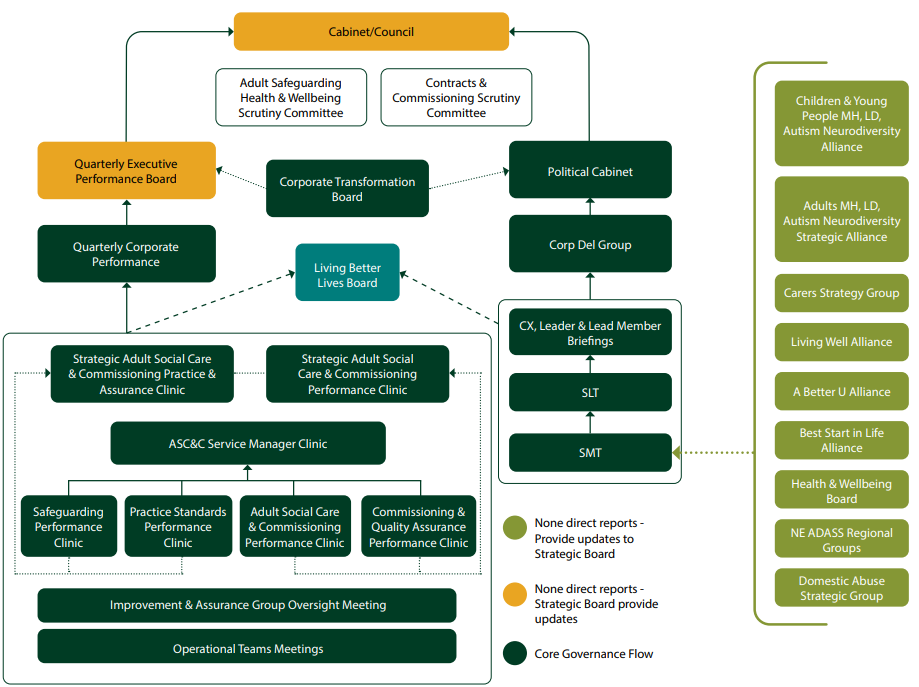
Adult social care and commissioning quality, assurance and performance governance structure
The overarching governance structure for the Council is made up of nine South Tyneside Councillors, who form the Cabinet. This Cabinet plays a crucial role in overseeing and guiding the strategic direction of adult social care and commissioning. They ensure that policies and decisions align with the needs of the community, providing accountability and leadership. The Cabinet’s involvement ensures that adult social care services are effectively integrated with other council services, promoting a cohesive approach to meeting the needs of South Tyneside residents.
Council governance structure
In South Tyneside we have adopted a Code of Corporate Governance which is consistent with the principles and requirements of the CIPFA/SOLACE framework for ‘Delivering Good Governance in Local Government’.
Our Council governance framework comprises the systems, processes, culture, and values by which we direct and control our activities and through which we account to, engage with, and lead our community. It enables us to monitor the achievement of our strategic objectives and to consider whether these lead to the delivery of appropriate, cost-effective services.
Assurance
A scrutiny committee of Members is responsible for checking the effectiveness of commissioning arrangements. Individual Adults and Children’s scrutiny committees hold senior officers and leadership to account on the performance of contracts when looking at whether specified outcomes are being delivered.
Commissioning governance process
The Council spends a significant amount of public money and therefore strong and robust processes are in place to monitor how this is done. We have a duty as a public body to ensure we operate within the law. Our commissioning strategy will be overseen by Head of Commissioning, Assurance and Reform who will ensure that this strategy is delivered and will receive regular updates and monitoring reports from the Commissioning Function. Integral to this is our continued commitment to joint working and following the principles of the Commissioning Collaborative and improving the health and wellbeing of residents.
Commissioning Annual Operating Service Plan
The Head of Commissioning, Assurance and Reform will produce an annual Commissioning Operating Service Plan that will define in more detail the key commissioning activities that will be completed over the following 12 months. This plan will include:
- Priority commissioning activities and timelines
- Commentary about each priority and the expected approach and model
- A resource plan
- Arrangements for reporting progress and performance
- KPIs
Governance Structure
Integration and alliance with the NHS
This strategy, though focused on adult social care, supports our colleagues within the NHS in delivering shared priorities. It reinforces our commitment to the Alliances that have been formed within South Tyneside to deliver the ambitions of the Joint Health and Wellbeing Strategy. The Council recognises that commissioning for care and support can never be done in isolation and is committed to continuing on the journey of collaborative commissioning through strategic direction from the Health and Wellbeing Board and the Place Committee of the North East and North Cumbria ICB. Working together will improve the health and wellbeing of our children, adults and families reduce current health inequalities and help people live longer, healthier and fulfilled lives.
Commissioning priorities and forward plan

We have completed an analysis of the current commissioning priorities for the service until April 2027. We did this by completing an analysis of the current commissioning portfolio against an agreed set of evaluation criteria.
This evaluation criteria included the following factors for each current commissioning activity strand and contract:
- Strategic alignment - the extent to which the activity aligns with and impacts on forward health and care strategies.
- Quality and feedback - the extent to which there are concerns about the current quality of services provided and/or where the current activity gains negative feedback on current arrangements.
- Impact on resident/reach - the extent to which the activity impacts on residents within the Borough.
- Expected value - the expected costs associated with the activity.
- Risk - the risks associated with the activity either to the safety of services provided, the risk of market challenges and the reputation of the Council and other relevant commissioning partners.
Each activity was scored using a consistent scoring model and cross-checked with existing service priorities and the views of expert Commissioners.
We also looked at where there are opportunities to simplify the existing commissioning model by consolidating activities and where the current commissioning approach needed a change in focus and/or specification.
This process led to the identification of 10 key strategic priorities which have been programmed over the next two years. Though these priorities have an adult social care focus, there are natural areas for collaboratively commissioning with colleagues from Children’s services, Public Health and the North East and North Cumbria ICB, where there are mutual benefits. These priorities are summarised in the table below.
Commissioning prioritisation
| Contract | 2025 | 2026 | 2027 | ||||||||||||||||||||||||||||||
|---|---|---|---|---|---|---|---|---|---|---|---|---|---|---|---|---|---|---|---|---|---|---|---|---|---|---|---|---|---|---|---|---|---|
| A | M | J | J | A | S | O | N | D | J | F | M | A | M | J | J | A | S | O | N | D | J | F | M | A | M | J | J | A | S | O | N | D | |
| Advocacy Contract | Production and evaluation, April 2025 to May 2025 | Mobilisation, June 2025 to August 2025 | Commencement, September 2025 | ||||||||||||||||||||||||||||||
| Independent Supported Living (Intermediate needs) | Strategy & Model, April 2025 to August 2025 | Documentation & Specification, September 2025 to May 2026 | Procurement & Evaluation, August 2026 to October 2026 | Mobilisation, November 2026 to January 2027 | Commencement, February 2027 | ||||||||||||||||||||||||||||
| Older People Care Homes | Strategy & Model, April 2025 to March 2026 | Documentation & Specification, April 2026 to October 2026 | Procurement & Evaluation, November 2026 to April 2027 | Mobilisation, May 2027 to June 2027 | Commencement, July 2027 | ||||||||||||||||||||||||||||
| Short Breaks, Respite & Day Services | Strategy & Model, April 2026 to June 2027 | Document & Specification, July 2027 to November 2027 | Procurement & Evaluation, December 2027 | ||||||||||||||||||||||||||||||
| Home Care & Reablement | Strategy & Model, April 2025 to February 2026 | Mobilisation, September 2026 to January 2027 | Commencement, February 2027 | Procurement & Evaluation, August 2027 to December 2027 | |||||||||||||||||||||||||||||
| Intermediate Care (Haven Court) | Strategy & Model, April 2025 to September 2025 | Documentation & Specification, October 2025 to May 2026 | Procurement & Evaluation, April 2026 to June 2026 | Mobilisation, July 2026 to August 2026 | Commencement, September 2026 | ||||||||||||||||||||||||||||
| Residential Framework – MH, LD & Autism | Strategy & Model, April 2026 to September 2026 | Documentation & Specification, October 2026 to March 2027 | Procurement & Evaluation, April 2027 to September 2027 | Mobilisation, October 2027 to November 2027 | Commencement December 2027 | ||||||||||||||||||||||||||||
| Housing Related Support - Supported by Corporate Transformation | Strategy & Model, April 2025 to December 2025 | Documentation & Specification, January 2026 to June 2026 | Procurement & Evaluation, July 2026 to December 2026 | Mobilisation, January 2027 to March 2027 | Commencement April 2027 | ||||||||||||||||||||||||||||
| Infrastructure Organisation - Supported by Corporate Transformation | Strategy & Model, April 2025 to October 2025 | Documentation & Specification, November 2025 to December 2025 | Procurement & Evaluation, January 2026 to April 2026 | Mobilisation, May 2026 to July 2026 | Commencement, August 2026 | ||||||||||||||||||||||||||||
| Consolidation of Voluntary Sector Statutory Services Part 1 (smaller contracts) | Strategy & Model, April 2025 to May 2025 | Documentation & Specification, June 2025 to July 2025 | Procurement & Evaluation, August 2025 to November 2025 | Mobilisation, December 2025 to January 2026 | Commencement, February 2026 | ||||||||||||||||||||||||||||
| Consolidation of Voluntary Sector Statutory Services Part 2 (larger/multiple contracts) | Strategy & Model, June 2025 to August 2026 | Documentation & Specification, September 2026 to December 2026 | Procurement & Evaluation, January 2027 to June 2027 | Mobilisation, July 2027 to August 2027 | Commencement September 2027 | ||||||||||||||||||||||||||||
Key
Strategy & ModelDocumentation & Specification
Procurement & Evaluation
Mobilisation
Commencement
The delivery of this plan provides the potential to transform the current commissioning landscape across South Tyneside and enable the following key benefits:
- The ability to create stronger strategic alignment between current commissioning models and key health and care strategies.
- Support to live better, more independent lives, with choice and control over care and support.
- Adoption services that are much more aligned with and based on the views of residents and carers, and what is important to them.
- The use of innovation and best practice in the design of services. Investing and growing use of assistive technology, to improve people’s outcomes and the way these are met.
- The opportunity to embed technology as a key component of efficient and effective working.
- The development of this strategy and our commissioning priorities have been drawn from our existing market statement and procurement register, and in conjunction with the Council’s Procurement Strategy - Procurement strategy and business process - South Tyneside Council
Developing the Commissioning Workforce
We are committed to developing a robust and skilled commissioning workforce within South Tyneside.
To ensure the delivery of high-quality services and the achievement of strategic priorities, the following positive actions will be undertaken:
Communication and messaging:
- • The Council will maintain a review of how communication strategies are working to evaluate effectiveness.
Ways of working:
- Efforts will continue to embed ‘Proud’ values within the department.
- The value of Standard Operating Procedures (SoP) for commissioning will be reviewed, and necessary changes implemented.
- Clear ways of working with key partners will be established, including those in health (joint commissioning and integration relationship), care providers, and individuals accessing support, using approaches such as co-production.
Prioritisation and foundations:
- Strategic commissioning priorities have been developed to create a shared understanding of objectives, success metrics, and implementation strategies. These priorities are directly related to the day-to-day activities that teams can influence.
- The agreed priorities contained within the Commissioning Annual Operational Service Plan will be subject to regular performance monitoring. The roles of each team and their joint working relationships in supporting delivery will be mapped.
- The Adult Social Care and Commissioning Directorate will establish effective ways of working and a collective understanding of achievements to date. The Forward Plan of priorities aligned with capacity will be implemented.
Staff support:
- A ‘training needs analysis’ will be undertaken with each staff member to create a team/function training plan.
- A Staff Development Programme will be created and shared to create shared commitment and cover specific training, personal development, formal training and ways of working.


Links to related strategies

- South Tyneside Council | Living Better Lives 2022-2026
- Our South Tyneside
- South Tyneside Council | All Age Autism Strategy 2022-2026
- South Tyneside Council | Learning Disabilities Strategy 2022-2026
- South Tyneside Council | Mental Health Strategy 2022-2026
- South Tyneside Council | Carers Strategy 2022-2027
- South Tyneside Joint Health and Wellbeing Strategy
- Better Health and Wellbeing For All Joint Forward Plan 2023-2028
- South Tyneside Council | South Tyneside Equality, Diversity, Inclusion and Belonging Strategy 2024-27
- Anti-Poverty Strategy - South Tyneside Council
- Procurement strategy and business process - South Tyneside Council
- A Better U
Glossary of terms
| Term | Description |
|---|---|
| Commissioning | The process of planning services for a group of people who live in a particular area. It does not always mean paying for services but making sure that the services people need are available in that area. |
| Commissioning activities | Understanding the health and care needs of the local community, planning, and designing services, selecting, and contracting providers to deliver these services, and continuously checking to ensure they are of good quality and meet people’s needs. This process helps ensure that the services provided are effective and beneficial for everyone. |
| Commissioned services | The services that are planned, organised, and purchased by the council to meet the needs of a community. |
| Co-production | Co-production as a way of working where people who use services and carers work together with professionals to design, deliver, and evaluate services. It ensures that the voices of those who use services are heard and valued. |
| High deprivation | This refers to areas where people face many social and economic problems, which can affect their health. |
| Independent commission | An independent commission is a body set up to investigate and provide recommendations on specific issues, often to ensure impartiality and thoroughness. |
| Intergenerational skills and health challenges | These are problems that affect different generations in families or communities, like long-term illnesses or unemployment. |
| Joint Strategic Needs Assessment and Assets (JSNAA) | The JSNAA is a statutory responsibility and is a process for assessing health and wellbeing needs of South Tyneside’s population. The JSNAA informs policy, commissioning, delivery and frontline practice to improve health and wellbeing, and tackle inequalities, including Joint local health and wellbeing strategies (JHLWSs). |
| Self-directed care | Allows individuals to have control over the care and support they receive, often through personal budgets, enabling them to tailor services to their specific needs. |
| Vision | An aspirational description of what an organisation would like to achieve or accomplish in the mid-or long-term future. It is intended to serve as a guide for choosing current courses of action. It should have a compelling aspect that serves to inspire, motivate, and engage. |
| Equality | Equality is about fairness, breaking down barriers and making sure that everyone has the same opportunities. |
| Diversity | Diversity is about recognising the ways in which people differ and celebrating these differences. |
| Inclusion | Inclusion is about actively ensuring that all people feel welcome, respected and able to take part in services or opportunities. |
| Belonging | Belonging is a vital social component of life that goes beyond acceptance into a group. It is the psychological feeling of connectedness, safety, power, wholeness and belonging to a social, spatial, cultural, or professional group. |